
Skip to content
Laxxon Medical

Laxxon Medical

The SPID® platform

SPID® (Screen Printed Innovative Drug) Technology is Laxxon's cold-process screen printing platform. With our patented technology, we can produce a generation of smart drug delivery systems (DDSs) with tailored pharmacokinetics based on advanced geometric internal structures, heterogeneous distribution of active ingredients, and choice of materials.

How the process works

  1. Step 1: Formulate

    Active ingredients and excipients are combined into a suspension (paste).

  2. Step 2: Print

    The paste is processed through a screen in a cold process, layer by layer, at 10 to 150 microns per layer.

  3. Step 3: Structure

    The layers form defined internal structures that determine the release profile and the combination of active ingredients.

  4. Step 4: Scale

    Depending on tablet size, one screen prints up to 40,000 tablets per cycle; the same process serves laboratory batches and larger volumes.

Layer thickness: 10 to 150 microns.

Release layerImmediate-release zoneBuffer zoneActive coreBase layer

What SPID® makes possible

Release profiles

  • Immediate, extended and sustained release
  • Zero-order release controlled by geometry or pH
  • Multiple enteric polymers for pH-controlled release along the entire GI tract
  • Sequential release
  • Pulsatile release

Architectures

  • Tablet-in-tablet, including a non-releasing buffer zone
  • Multi-compartment tablets
  • Multi-compartment microtablets smaller than 1 mm

Dosage forms

  • Oral delivery of macromolecules and peptides such as GLP-1 RA
  • Gummies and chewable tablets
  • Oral thin films
  • Orodispersible tablets

Focus program · LXM.2

An oral GLP-1 RA, enabled by SPID® technology

The challenge

Most GLP-1 RA medicines are peptides, and peptide medicines usually have to be injected. Peptides are large molecules that pass poorly through the gut wall and are broken down by enzymes and bacteria in the gastrointestinal tract. As a result, only a small fraction of an oral dose reaches the bloodstream (low oral bioavailability).

The approach

SPID® prints without heat, so heat-sensitive active ingredients such as peptides stay intact. SPID®-printed dosage forms are designed to protect the peptide from enzymes and bacteria on its way through the gastrointestinal tract and to release it where it can be absorbed, with the aim of improving oral bioavailability. For LXM.2, Laxxon is developing SPID®-printed oral GLP-1 RA microtablets.

The status

In preclinical development, with Phase 1 planned for 2027.

Sources: Drucker DJ, Advances in oral peptide therapeutics, Nature Reviews Drug Discovery 2020;19:277–289; company information and press release of October 21, 2026.

LXM.2 in the pipeline →

Intellectual property and license

Laxxon builds its own intellectual property, including US Patent 11,419,824 B2 on the sequential release of multiple active ingredients, granted in 2022. Since 2017, Laxxon has held the exclusive worldwide license from Exentis Group AG and Exentis Knowledge GmbH for pharmaceutical applications of the technology behind SPID®.

Patents and patent applications
More than 230, own and in-licensed
Patent terms
Potentially extending into 2046
Source
Company figures, as of November 2026

Evidence and publications

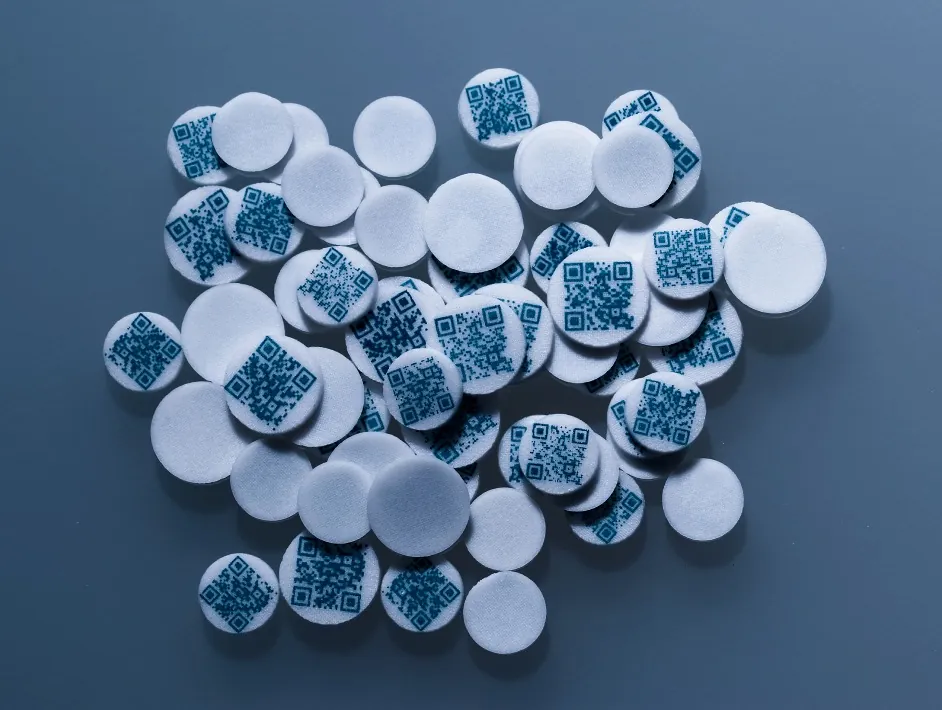
Printed tablets, some carrying a printed QR code

Bioavailability (animal study)

In a published animal pharmacokinetic study, LXM.5 (levodopa/carbidopa) showed more than 380% higher bioavailability than Sinemet®.

Source: Enke M, Bünger M, Aedtner E, Kastner S, Gruschwitz F, Kühne K, Czernik-Schulz D, Greeley DR, Volc D, Buzachnich-Ladinig A, Schneeberger A. Three-Dimensional Screen Printing Technology Enables Sequential Release of Carbidopa and Levodopa—A New Approach Improving Levodopa Delivery for Treating Parkinson’s Disease. Pharmaceutics. 2025;17(12), 1507. https://doi.org/10.3390/pharmaceutics17121507

Anti-counterfeiting

A peer-reviewed study showed that the printing process behind SPID® can integrate covert anti-counterfeiting features into tablets.

Source: Schwarz N, Enke M, Gruschwitz FV, Winkler D, Franzmann S, Jescheck L, Hanf F, Schneeberger A. 3D Screen Printing Offers Unprecedented Anticounterfeiting Strategies for Oral Solid Dosage Forms Feasible for Large Scale Production. Pharmaceutics. 2024;16(3), 368. https://doi.org/10.3390/pharmaceutics16030368

Full list of publications →

Designed to scale

The same printing process serves laboratory batches and larger volumes. Laxxon prints development batches at its research and development site in Jena, Germany; clinical-scale cGMP manufacturing for its programs is being established with CDMO partner Adare Pharma Solutions in Pessano (Milan), Italy. Depending on tablet format, a production printer prints up to 1.5 million tablets per day; a scale-up to more than 3 million tablets per day is planned (company figures).

Discuss your molecule

Talk to our team about a development project.

Contact us